
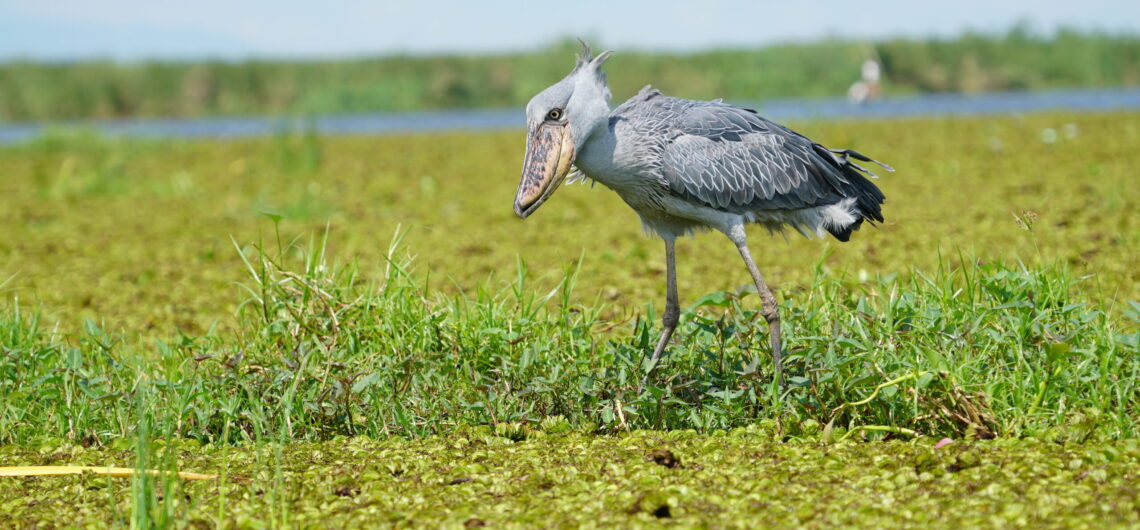
The shoebill stork looks like something from Jurassic Park. But is it really a dinosaur? Here’s the truth plus where to find one in Uganda on a safari.
The first time most people see a shoebill stork, they think the same thing. That cannot be real. It stands nearly five feet tall. It has a beak the size of a Dutch wooden shoe. Its eyes are cold, yellow, and completely still. It does not move. It just stares at you slowly, deliberately, like it has been on this earth long before you arrived and fully expects to be here long after you leave.
And in a way, it has been.
The shoebill stork is one of the most extraordinary birds alive today. It looks prehistoric because, in many ways, it is. People search for it from all over the world. Birdwatchers put it at the very top of their lifetime wish lists. Photographers travel to the swamps of Uganda specifically to spend one quiet morning in a canoe, waiting for this bird to turn its enormous head and look directly at them.
If you have ever wondered whether the shoebill stork is related to dinosaurs, whether it can fly, whether it is dangerous, or where exactly you can find one, this guide answers all of it. And if you are a traveler thinking about Uganda, we want to show you why a shoebill safari belongs on your itinerary.
So, Is the Shoebill Stork Actually a Dinosaur?
The Short Answer- Not Exactly. But the Connection Is Real.
The shoebill stork is not a dinosaur. However, it is directly descended from them.
Scientists have confirmed that all modern birds evolved from a group of meat-eating dinosaurs called theropods, the same group that included the Tyrannosaurus rex. That discovery was solidified in the 1990s, when fossilised feathered dinosaurs were found for the first time. From that point on, the link between birds and dinosaurs went from theory to scientific fact.
So, technically, every bird you have ever seen is a descendant of a dinosaur. But the shoebill carries those prehistoric roots more visibly than almost anything else alive. Its rigid posture, its reptilian stare, its cold patience, and its violent hunting style all feel like they belong in a different era entirely. When you watch a shoebill catch a lungfish, observers consistently say it looks like something out of Jurassic Park, not because the comparison is poetic, but because it genuinely does.
Its Scientific Name Tells the Story
The shoebill’s scientific name is Balaeniceps rex. That last word, rex, means king. It shares that suffix with Tyrannosaurus rex, the most famous theropod of all. That is not a coincidence people miss easily.
What Does the Shoebill Stork Actually Look Like?
A Bird Built Like No Other
Standing next to a shoebill is a genuinely strange experience. It can reach up to 1.5 metres tall, which is taller than many children and level with the chest of most adults. Its wingspan stretches up to 2.5 metres across. Its overall plumage is a blue-grey colour, dark and slate-like, which helps it disappear into the papyrus reeds and shadows of the swamp.
But the feature that defines the shoebill, the thing that makes every photo of it look like digital art, is the beak.
The Beak 24 Centimetres of Pure Prehistoric Engineering
The shoebill’s bill measures up to 24 centimetres long and 20 centimetres wide. It is shaped almost exactly like a Dutch clog or a shoe, which is precisely where the name comes from. The tip curves into a sharp, powerful hook.
That beak is not decorative. It is a weapon. The shoebill uses it to grab, crush, and sometimes decapitate prey in a single strike. It can kill a six-foot lungfish. It has been documented catching juvenile crocodiles. Its hunting success rate is around 60 percent per strike, remarkably high for a wading bird.
When a shoebill snaps its beak shut, it makes a sound like a machine gun, a rapid, hollow clattering that carries across the swamp. Local people near Mabamba Swamp in Uganda describe hearing that sound as the signal that the shoebill has found something worth hunting.
Where in Africa Is the Shoebill Stork Found?
A Bird of Very Specific Habitats
The shoebill is found in central and eastern Africa, but only in very specific places. It needs freshwater swamps and papyrus marshes with shallow water, plenty of lungfish, and very little human disturbance. It is not a bird that adapts easily to change.
Its range covers parts of South Sudan, Uganda, western Tanzania, eastern Democratic Republic of Congo, Rwanda, northern Zambia, and pockets of Ethiopia, Kenya, and Cameroon.
Of all these countries, Uganda holds the most reliable and accessible shoebill populations in the world. It is estimated that Uganda is home to around 1,000 shoebill storks, roughly 15 to 30 percent of the entire global population. More importantly, Uganda’s wetlands are protected, its local guides are exceptional, and the birds can be found with relative consistency year-round.
How Rare Is the Shoebill Stork?
The Numbers Are Quietly Alarming
The shoebill is listed as Vulnerable on the IUCN Red List, the same international authority that classifies endangered species worldwide. The total global population is estimated at between 3,300 and 5,300 mature individuals. Some estimates go slightly higher, up to 8,000, but all sources agree the trend is downward.
To put that in perspective, there are fewer shoebill storks alive today than there are mountain gorillas and rhinos combined. This is an extraordinarily rare bird.
The main threats to its survival are habitat loss, wetlands being drained for agriculture and development, as well as human disturbance near nesting sites, illegal capture for the live bird trade, and climate change, causing droughts that dry out the swamps it depends on. The shoebill breeds slowly. It lays one to three eggs, but typically raises only one chick successfully. Recovery from population decline is painfully slow.
Seeing one in the wild is not just an extraordinary experience. It is a reminder of how fragile some of the world’s most ancient creatures actually are.
Does the Shoebill Stork Fly?
Yes, But It Prefers Not To
This is one of the most common questions people ask about the shoebill, and the answer surprises many people. Yes, the shoebill can fly. It has a wingspan of up to 2.5 metres and is fully capable of sustained flight. However, it rarely chooses to.
The shoebill is famous for its extraordinary stillness. It can stand completely motionless in shallow water for up to two hours, waiting for prey to move within striking distance. Walking is its preferred mode of movement. Flying, when it happens, tends to cover short distances between feeding areas or nesting sites.
Is the Shoebill Stork Dangerous to Humans?
Intimidating But Not a Threat
The shoebill’s stare is one of the most unsettling things in nature. It watches you with total stillness, head turned slightly, eyes completely fixed. Many people describe feeling genuinely nervous standing near one for the first time.
But the shoebill is not dangerous to humans. It is naturally shy and generally avoids human contact. In the wild, a shoebill that senses people approaching will usually retreat deeper into the reeds. It does not attack, it does not chase, and it has no interest in confrontation with anything it cannot eat.
In fact, shoebills have been observed doing something quite charming. The famous shoebill named Sushi, who lives at the Uganda Wildlife Education Centre in Entebbe, allows visitors to approach but only if they bow first. The bird actually bows back. It has become one of the most photographed moments in Ugandan wildlife tourism, and it perfectly captures the strange, dignified character of this bird.
Where to Find the Shoebill Stork in Uganda
Uganda Is the Best Place on Earth to See This Bird
Uganda has over nine confirmed locations where shoebill storks can be found. Each one offers a different experience. Here are the most important ones.
Mabamba Swamp- The Top Spot for Shoebill Tracking
Mabamba Bay Wetland is Uganda’s most reliable location for seeing the shoebill stork, and arguably the most reliable spot in the world. It sits on the northern shore of Lake Victoria, just 50 kilometres west of Kampala and about an hour’s drive from Entebbe International Airport.
Mabamba was designated a Ramsar Wetland of International Importance in 2006, recognising its critical role in conserving biodiversity. The swamp covers over 2,400 hectares of dense papyrus, floating vegetation, and narrow channels winding through one of the richest bird habitats in East Africa.
The experience here is done by canoe, guided by local fishermen who have been converted from fishing to conservation work. These guides know every corner of the swamp. They know which channels the shoebills favour, what time of morning they stand still long enough to photograph, and how to paddle silently enough not to disturb them.
A half-day Mabamba birding excursion costs very little and can be added to the start or end of any Uganda safari. For many travelers, it is genuinely one of the highlights of their entire trip.
Best time to visit: Year-round, but early mornings during the dry seasons (December to February and June to August) give the best sighting conditions.
Murchison Falls National Park
Murchison Falls National Park offers a completely different shoebill experience. Here, the bird is found in the Nile Delta, where the Victoria Nile flows into Lake Albert through a vast, remote marshland of papyrus channels and reed beds.
Access to the delta is by boat safari departing from Paraa, the park’s main hub. Early morning and late afternoon cruises are the most productive. The scenery is extraordinary: crocodiles on the banks, hippos surfacing around you, elephants at the water’s edge, and the roar of Murchison Falls audible in the distance. Spotting a shoebill standing motionless in the reeds against that backdrop is an experience that is very difficult to describe properly.
Unlike Mabamba, where the shoebill is the star attraction, at Murchison the shoebill is part of a much richer safari experience that includes big game, primates, and one of Africa’s most powerful waterfalls.
Ziwa Rhino Sanctuary
Ziwa Rhino Sanctuary, located between Kampala and Murchison Falls, is the only place in Uganda where you can walk alongside white rhinos on foot. But it also contains Lugogo Swamp, which is home to resident shoebill storks.
An early morning canoe trip through Lugogo Swamp gives you a realistic chance of seeing the shoebill in a quieter, less-visited setting. And because Ziwa is a stop on the route to Murchison Falls, combining rhino tracking and shoebill spotting in a single morning is both practical and extraordinary.
Other Notable Shoebill Locations in Uganda
Lake Mburo National Park, boat cruises along the lake’s marshy fringes regularly yield shoebill sightings. A good add-on for travelers heading southwest toward Bwindi.
Makanaga Swamp, on Lake Victoria, is quieter than Mabamba and excellent for photographers who want more space and fewer people.
Lwera Swamp, along the Kampala-Masaka highway, a lesser-known spot that local birding guides know well.
Semuliki National Park, on the edge of the Congo Basin, is more remote and seasonal, but offers the most wild and untouched shoebill habitat in Uganda.
Uganda Wildlife Education Centre, Entebbe, if you arrive in Uganda with limited time, UWEC in Entebbe is home to resident shoebills, including the famous Sushi. Not a wild experience, but a guaranteed close encounter before you fly home.
Why You Should Do a Shoebill Safari in Uganda
This Is Not Just Birdwatching. It Is Something Else Entirely.
We talk to a lot of travelers who say they are not particularly into birds. They come to Uganda for gorilla trekking, for the Nile, for the tree-climbing lions. And then, almost by accident, they spend a quiet morning in a canoe at Mabamba, and the shoebill safari becomes the thing they talk about most when they get home.
There is something about this bird that gets to people on a deeper level. Maybe it is the stillness. Maybe it is the feeling of looking at something genuinely ancient. Maybe it is the fact that fewer than 5,300 of them remain on earth, and you are sitting two metres away from one of them in a papyrus swamp at sunrise, and the world is completely silent.
Whatever it is, a shoebill encounter in Uganda is not just a wildlife sighting. It is one of those rare moments that makes people stop and feel the weight of what they are looking at.
How to Add a Shoebill Safari to Your Uganda Trip.
A Mabamba Swamp shoebill excursion can be done as a half-day or full-day trip from Entebbe or Kampala. It fits easily into the beginning or end of any Uganda safari itinerary, even for travelers with just one free morning before a flight.
For a longer shoebill experience, we combine Mabamba with Murchison Falls and Ziwa Rhino Sanctuary into a dedicated birding and wildlife itinerary that gives you three completely different settings for seeing this extraordinary bird.
We are a local tour operator based in Kampala. We plan shoebill safaris and Uganda birding trips alongside gorilla trekking, game drives, and all other Uganda safari experiences. Shoebill day trips from Entebbe start from $100 per person.
Get in touch with our team today and let us put this bird on your itinerary. You will not regret it.

Comments