
No upper age limit. No fitness test. Here’s how seniors trek gorillas in Uganda – sedan chairs, porter support, best sectors & real tips from a local operator.
Age alone has never been the barrier that most people assume it is. We have personally arranged gorilla treks for travelers in their 70s and 80s – some on foot with a porter’s steady hand, others carried gently through the forest in a sedan chair. Every single one of them spent their full, uninterrupted hour with a mountain gorilla family in Bwindi Impenetrable Forest.
This guide covers everything a senior traveler or someone planning for one – needs to know. The official age policies. The honest difficulty level. The support services available. The best sectors of Bwindi. How to prepare. And the answers to every question we get asked regularly. Read it from start to finish, or jump straight to the section that answers your question.
Can Elderly People Go Gorilla Trekking in Uganda?
The Direct Answer
Yes, and there is no upper age limit. Uganda Wildlife Authority does not restrict gorilla trekking based on a traveler’s age. What matters is general health, a willingness to communicate mobility concerns in advance, and a readiness to use the support services that exist specifically for this purpose.
We have personally guided clients in their 70s and 80s through Bwindi. Some walked the full trail with a porter’s support. Others used a sedan chair for part or all of the trek. All of them spent their full hour with a gorilla family, the same one hour that every other visitor gets, regardless of how they arrived.
Senior travel groups, retirement tour operators, and accessible travel organizations regularly report octogenarians completing gorilla treks in both Uganda and Rwanda’s Volcanoes National Park. This is not a rare exception. It happens every trekking season.
Why This Surprises So Many People
Most people assume gorilla trekking requires the fitness of a serious hiker. That impression comes from photos of steep, muddy trails and stories of multi-hour forest walks. Those things are real, but they are only part of the picture. The other part involves porter teams, sedan chairs, group allocations based on fitness, and guides who have spent years helping travelers of every ability level reach the gorillas safely.
Is There an Age Limit for Gorilla Trekking in Uganda?
Minimum Age – Strictly 15 Years Old
Uganda Wildlife Authority sets a minimum age of 15 years for all gorilla trekking. This applies equally in Bwindi Impenetrable National Park and Mgahinga Gorilla National Park, with no exceptions made for maturity or fitness level. The rule exists to protect both visitors and the gorilla families themselves.
Maximum Age – There Is None
There is no official maximum age. UWA does not set an upper limit. A fit 72-year-old can join a standard trek with no special arrangements at all. A less mobile 68-year-old may benefit significantly from porter assistance or a sedan chair. The deciding factors are always fitness and mobility, not age on its own.
This matters because many senior travelers rule themselves out before they have spoken to anyone about what is actually possible. What determines it is how well you understand the options available, and how early you communicate your needs to your operator.
How Difficult Is Gorilla Trekking for Seniors?
Trek Duration and Terrain Vary Enormously
This is the part most websites skip over, and it is the most important thing for senior travelers to understand. Gorilla trekking difficulty is not fixed. It changes every single day depending on where the gorilla family has moved overnight.
Trek duration ranges from as little as 30 minutes to as long as 8 hours, round trip. Bwindi’s terrain spans elevations from 1,160 to 2,607 metres. Trails can be steep, narrow, slippery after rain, and dense with roots and vegetation. On some days, the assigned gorilla family rests close to the trailhead. On others, trackers locate them deep in more demanding terrain. No one knows exactly what a particular day will bring until the trackers radio in that morning.
This unpredictability is precisely why informing your operator about mobility or fitness concerns well in advance is so important. It allows time to coordinate a suitable group assignment with park authorities before your trekking day.
What a Typical Senior-Friendly Trekking Day Looks Like
The day begins at 7:30am at the Uganda Wildlife Authority headquarters for a ranger briefing. Groups are assigned to specific gorilla families. Rangers consider the fitness and mobility levels of travelers during this process, particularly for clients who have communicated special needs in advance.
From the trailhead, your ranger guide, trackers, and porter team move at a measured pace. Stops happen frequently and naturally, to check the trail, listen for tracker radio updates, or simply rest. Dense forest terrain does not allow for fast walking even among younger visitors, so the pace of gorilla trekking in Bwindi already works in a senior traveler’s favour.
Once the gorilla family is located, your one hour begins. That hour is identical for every visitor the same proximity, the same time, the same experience – regardless of how long the trek took or how you arrived.
Why Many Seniors Manage Better Than They Expected
We hear this regularly from clients after their trek. They expected something more difficult than what they experienced. The reason is usually the same: the slow, deliberate pace of the forest, the natural stop-and-start rhythm of following trackers, and the presence of a porter who takes the strain of the bag and offers a steadying hand at every difficult step, these things combine to make the physical demand much more manageable than it looks on paper.
What Assistance Is Available for Senior Gorilla Trekkers?
Porter Services – The Most Important First Step
Hiring a porter is the single most practical thing any senior traveler can do to make gorilla trekking easier and safer. A porter carries your backpack, steadies you on steep or slippery sections, pushes from behind on uphill stretches, and pulls you forward on descents. The physical support they provide is constant and entirely adapted to your pace and needs.
Porter fees run approximately $15 to $20 per trek. We strongly recommend every senior traveler hires a porter regardless of fitness level, the cost is modest, the benefit is significant, and porters are local community members from the villages surrounding Bwindi for whom this work provides a meaningful income.
The Gorilla Trekking Sedan Chair – The African Helicopter
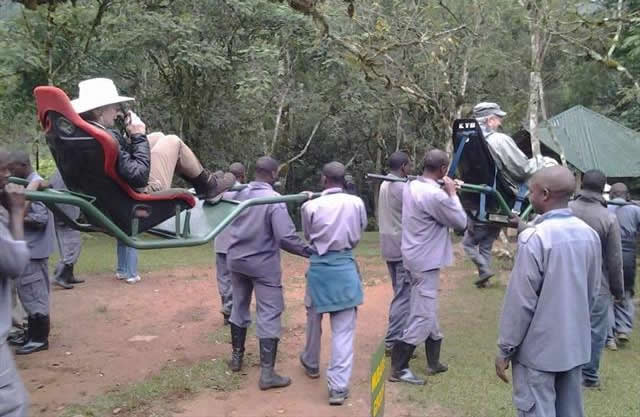
For travelers whose mobility makes walking the trail unrealistic, Bwindi offers the sedan chair, also known locally as the “African Helicopter.” This service exists specifically for elderly travelers, people with disabilities, and anyone who simply cannot manage the physical demands of the trail on foot.
The sedan chair must be booked in advance through your tour operator. We will explain the full experience in the dedicated section below.
Flying to Bwindi Instead of Driving
The drive from Kampala or Entebbe to Bwindi takes 9 to 10 hours each way, a significant physical toll on any traveler, and especially on older adults. This is actually one of the concerns senior travelers raise most often, and the solution is straightforward.
Charter flights from Entebbe or Kajjansi Airstrip to Kihihi or Kisoro airstrips reduce travel time to approximately 90 minutes. For senior travelers, flying in is the single most effective way to arrive at Bwindi rested, comfortable, and ready to trek. It adds to the total cost but dramatically reduces the physical fatigue of the journey.
An alternative is to start from Kigali, Rwanda, which cuts the drive to Bwindi to just 4 to 5 hours. We regularly plan cross-border gorilla trips for senior clients who fly into Kigali and drive to Bwindi from there, it is a much more manageable travel day.
How Rangers Assign Groups Based on Fitness
On the morning of your trek, rangers consider the fitness and mobility of every traveler in each group. Gorilla families whose location is closer to the trailhead, or whose terrain is more moderate, are preferentially assigned to older or less mobile travelers where possible.
This allocation is not guaranteed, because gorilla families move independently and their location that morning is determined by trackers, not rangers. However, communicating your needs to your operator weeks before arrival so that the park authorities can factor this into permit allocation, meaningfully improves your chances of a gentler day.
The Gorilla Trekking Sedan Chair: Full Guide for Senior Travelers
How the Sedan Chair Works
The sedan chair is a sturdy, padded seat mounted on long carrying poles, carried through the forest by a trained team of four to eight porters. Rather than walking the trail yourself, you are carried steadily and safely to the location where the gorilla family has been found by trackers.
Once you arrive at the gorilla family, you can choose to remain in the chair for your full hour of viewing, or step out to stand or sit nearby if you prefer and are able. The experience of being with the gorillas is completely identical to that of every other trekker that day.
Who Should Book the Sedan Chair
The sedan chair is for anyone who needs it. We arrange it for elderly travelers, clients recovering from surgery or injury, travelers with chronic joint conditions or limited mobility, and anyone who simply would rather not take the physical risk of an uneven forest trail. There is no qualifying condition required.
It must be arranged in advance, not on the morning of the trek. Booking ahead gives us time to assemble the porter team, confirm with park authorities, and ensure everything is ready at the trailhead when you arrive. Last-minute requests cannot always be accommodated.
Comfort and Safety in the Chair
The porter teams who carry the sedan chair are experienced specifically in this work. Many have done it for years. They know how to navigate Bwindi’s steep, root-covered, sometimes muddy terrain while keeping the chair level and the passenger stable. Porters communicate constantly with each other throughout the journey to manage uneven ground.
Most clients who use the sedan chair describe the experience as surprisingly comfortable. The motion is steady. The forest passes close on all sides. And the anticipation of what is ahead builds exactly the same as it does for anyone walking the trail on foot.
Cost of the Sedan Chair Service
The sedan chair typically costs $300 to $500 per trek, in addition to the standard gorilla trekking permit. The exact amount depends on the trail conditions that day, the sector, and the number of porters required. While this is a meaningful additional cost, travelers who have used it consistently describe it as the best money spent on their entire trip, because without it, the trip would not have happened at all.
What Your Full Sedan Chair Day Looks Like
Your day begins exactly like every other trekker’s. Early breakfast at your lodge. Transfer to UWA headquarters by 7:30am for the group briefing. Your gorilla family assignment is confirmed. Then, at the trailhead, your porter team helps you into the chair and your journey into the forest begins.
Porters move at a measured, careful pace. The forest surrounds you completely, the smell of it, the sounds of it, the light filtering down through the canopy. When the trackers radio in the gorilla family’s location, your group converges, and you arrive.
The gorillas pay no attention to how you got there. A silverback weighing over 200 kilograms may sit five metres away from you, chewing vegetation, watching you with that ancient, unhurried calm. Young gorillas play in the undergrowth. A mother nurses her infant on a low branch. Your full hour unfolds exactly as it does for everyone else.
The return journey follows the same route back to the trailhead, where your vehicle is waiting.
Best Gorilla Trekking Sectors in Bwindi for Senior Travelers
Bwindi Impenetrable National Park is divided into four trekking sectors. For senior travelers, sector choice matters significantly, it affects terrain difficulty, distance to the nearest trailhead, and the range of accommodation available nearby.
Buhoma – Most Accessible for Seniors
Buhoma is the most established and generally most accessible sector in Bwindi. It has some of the longest-habituated gorilla families, moderate terrain compared to the other sectors, and the widest range of accommodation nearby, from budget guesthouses to comfortable mid-range lodges, all within a short drive of the park gate.
Some habituated gorilla families in Buhoma are located within 2 to 3 kilometres of the trailhead, which gives rangers real flexibility to assign closer families to less mobile travelers. For a first-time senior trekker, Buhoma is our most frequent recommendation.
Rushaga – Best Permit Availability for Seniors
Rushaga has the highest number of habituated gorilla families of any sector in Bwindi, which means the best permit availability, especially during peak season months when other sectors book up quickly. For senior travelers booking at shorter notice, this is a significant advantage.
Rushaga also offers the Gorilla Habituation Experience, a full-day encounter with a semi-habituated gorilla group. For senior travelers with strong fitness and stamina, this extended experience can be deeply rewarding. However, it requires more time in the forest than a standard trek and should be assessed carefully based on individual fitness.
Ruhija – Shorter Trek Distances, Cooler Climate
Ruhija sits at the highest altitude of the four sectors and is sometimes recommended for seniors because gorilla families here are frequently located close to the trailhead – meaning shorter actual trekking distances on the day. The climate is cooler and often misty, which many older travelers find more comfortable than trekking in heat.
The trade-off is altitude. At Ruhija’s elevation, the thinner air can place additional strain on travelers with respiratory or cardiac conditions. We recommend discussing this with your doctor before choosing this sector if either condition applies to you.
Nkuringo – Not Recommended for Limited Mobility
Nkuringo is the most physically demanding sector in Bwindi and is generally not recommended for senior travelers with mobility concerns. The terrain involves steep, sustained descents and ascents through very dense forest. The experience is spectacular and wild – but the physical demands are consistently high regardless of where the gorilla family is located on a given day.
How to Prepare for Gorilla Trekking as a Senior
Physical Preparation
You do not need to train like an athlete. You simply want your body reasonably accustomed to sustained walking before you arrive. In the weeks before your trip, regular walks on varied terrain, including hills or stairs where possible – make a genuine difference. Even 30 minutes of brisk walking three or four times per week builds the kind of leg strength and cardiovascular readiness that helps significantly on the day.
Medical Considerations
Speak with your doctor before booking, particularly if you have heart conditions, joint problems, high blood pressure, or any condition affected by altitude or exertion. Bring a full supply of any regular medications, along with a written list of conditions and prescriptions in case of emergency. Inform your tour operator of any health conditions that rangers or guides should be aware of before the trek.
Yellow fever vaccination is mandatory for entry into Uganda, ensure this is up to date well before travel. Additional vaccinations against hepatitis A, typhoid, and tetanus are advisable.
Travel Insurance
Travel insurance is non-negotiable for senior travelers. Confirm in writing with your insurer that your policy covers gorilla trekking as an activity, includes emergency medical evacuation, and has no exclusions related to pre-existing conditions that could affect a claim. Do this before you pay any deposit on your safari.
What to Pack
The following items are essential for every senior traveler doing a gorilla trek in Bwindi:
- Waterproof hiking boots with good ankle support, even if using a sedan chair, you will walk short distances
- Lightweight rain jacket – Bwindi is a rainforest and rain can come quickly
- Long-sleeved shirt and long trousers tucked into long socks for protection against safari ants
- Gardening gloves – helpful for gripping vegetation on steep sections
- Walking stick or trekking poles – excellent for stability on uneven ground
- Wide-brimmed hat for protection from sun on open sections of the trail
- At least 2 litres of water – hydration at altitude matters more than people expect
- Energy snacks for the trek and the return journey
- Printed medication list kept in a dry bag throughout the trek
Practical Tips for a Comfortable Senior Gorilla Trek
- Tell your operator everything, before you book. Do not wait until arrival to mention mobility limitations, recent surgery, or health conditions. The earlier we know, the better we can arrange group allocation, sedan chair, and suitable accommodation.
- Hire a porter. Always. Even if you feel fit and confident, a porter’s steady hand on difficult terrain is valuable insurance. The cost is modest and the benefit is real.
- Hydrate constantly. At Bwindi’s altitude, exertion dehydrates you faster than usual. Sip water regularly throughout the trek even when you do not feel thirsty.
- Pace yourself and speak up. There is no prize for speed. Tell your guide the moment you need to slow down or rest. Experienced rangers adjust without question.
- Dress in layers. Bwindi mornings are cool. The forest warms as you move. Layers let you adjust without carrying excess clothing.
- Fly to Bwindi if the drive concerns you. A 90-minute charter flight from Entebbe is far less physically taxing than a 10-hour road journey. For senior travelers, arriving rested matters.
- Consider flying in and driving out. Or the reverse. One long drive versus none is still a significant improvement for older travelers.
- Choose Buhoma or Rushaga for your first trek. Both offer more flexibility in group allocation than Nkuringo or the higher sections of Ruhija.
Frequently Asked Questions
Can a 70-year-old go gorilla trekking in Uganda?
Yes. A 70-year-old in reasonably good health can trek gorillas in Uganda, typically with the support of a porter. Many of our clients in their 70s have completed successful gorilla treks. Some walk the full trail with assistance. Others use a sedan chair for the more demanding sections.
Can an 80-year-old go gorilla trekking in Uganda?
Yes. There is no maximum age limit, and we have personally arranged successful gorilla treks for travelers in their 80s. A sedan chair is often the right choice at this age, though some 80-year-olds in strong health choose to walk with a porter instead. Each person is assessed individually.
Is gorilla trekking safe for senior travelers?
Gorilla trekking is generally safe for seniors who prepare sensibly – using a porter or sedan chair when appropriate, pacing themselves, staying hydrated, and consulting a doctor before traveling if they have existing health conditions. Every trek is led by armed Uganda Wildlife Authority rangers trained in wildlife management and emergency response.
What happens if I cannot complete the trek?
If a sedan chair has been arranged in advance, this situation rarely arises because you are carried rather than walking. If you have not arranged a sedan chair and find the trek too difficult partway through, your guide and porter will assist you and in some cases a sedan chair can be brought to you – though this option works best when planned ahead of time.
How much does the gorilla trekking sedan chair cost?
The sedan chair typically costs $300 to $500 per trek, in addition to the standard gorilla permit. The exact amount depends on trail conditions that day, the sector, and the number of porters required.
Can people with mobility issues see mountain gorillas in Uganda?
Yes. The sedan chair service exists precisely for this purpose and has made gorilla trekking accessible for travelers who would otherwise not be able to participate. Many clients who use wheelchairs at home, or who have significant joint or mobility conditions, have completed successful gorilla treks using this service.
Do I need to be fit to go gorilla trekking as a senior?
A basic level of fitness helps, but strict athletic fitness is not required. Hiring a porter, choosing an accessible sector like Buhoma or Rushaga, and using a sedan chair if needed all significantly reduce the physical demands of the day.
How many porters carry the sedan chair?
The sedan chair is carried by a team of four to eight trained porters, depending on trail difficulty and the individual’s needs on the day.
Do I need to book the sedan chair in advance?
Yes, strongly recommended. Booking in advance ensures the porter team and chair are ready at the trailhead on your specific trekking day. Last-minute requests on the morning of the trek cannot always be fulfilled.
Will I still get a full hour with the gorillas if I use a sedan chair?
Yes. The one-hour gorilla viewing time is the same for every visitor, regardless of how they arrived. The sedan chair changes the journey. It does not change the experience.
Is altitude a concern for elderly gorilla trekkers?
It can be, particularly for travelers with respiratory or cardiac conditions. Bwindi sits between 1,160 and 2,607 metres elevation. We recommend discussing this with your doctor before booking and choosing a lower-altitude sector like Buhoma where possible. Flying to Bwindi also eliminates the altitude change of a long road journey.
What is the minimum age for gorilla trekking in Uganda?
The minimum age is 15 years old, set by Uganda Wildlife Authority. No exceptions are made regardless of maturity or physical fitness.
Conclusion
Gorilla trekking for seniors in Uganda is not the exception. It is one of the most regularly arranged experiences we plan from our office in Kampala. Travelers in their 70s and 80s, some walking with a porter, some carried through the forest in a sedan chair, share the same extraordinary hour with a mountain gorilla family that every other visitor gets. Age does not change what happens in that forest. It is the same silverback, the same ancient calm, the same moment that people carry with them for the rest of their lives.
What makes it work is preparation. Knowing your own fitness level. Telling your operator about any health or mobility concerns early enough for them to arrange the right support. Choosing the right sector of Bwindi. Booking a porter. Arranging a sedan chair if needed. None of these steps are complicated. All of them make the difference between a trip that happened and a trip that almost did not.
We are a local tour operator based in Kampala. We arrange gorilla trekking safaris for travelers of every age and every fitness level. We book permits directly with Uganda Wildlife Authority. We know every sector of Bwindi, every budget lodge and mid-range and luxury property nearby, and every detail of planning a senior-friendly gorilla safari that actually works.
Get in touch with our team today. Your gorillas are waiting, and age is not going to stop you.

Comments